
|
Download this newsletter |
|
Missions, like anything involving large numbers of people, goes through cycles or trends. In this letter, we reflect on a the one such trend and its unfortunate consequences for the mission enterprise in Chad. Sometime back in the 70’s or 80’s, missiologists observed that all the low hanging fruit of Christendom in South America, Oceana, and sub-Saharan Africa had been picked, while huge swaths of mostly Muslim and Buddhist territory in Asia remained completely “unreached.” More distressingly, they also noted that the vast majority of missionaries still preferred to work in the amiable environs of “reached” areas. Thus began a seismic shift in the world of missions away from the traditional fields of ministry and towards these very difficult areas of the world. The admirable goal was nothing less than to see the Great Commission achieved in its entirety. Now, 30 years later, if our observations of missionary work in Chad are anything to go by, the shift is complete. Virtually every new missionary to Chad heads off to the Muslim part of the country. With the exception of a few denominational missionaries working with the Baptist and Grace Brethren churches, no new missionaries have come to work long term with the “reached” tribes in the south of Chad in well over a decade. This makes us, as missionaries to a “reached” people group wonder if it isn’t time for the pendulum to swing back. In hundreds of under-developed, marginalized tribes of Africa where churches already exist in some form (like the Kwong), the western missionary still has much to offer. Bible translation and discipleship would certainly top the list, but there are other more subtle, but no less important contributions he or she can make. Westerners bring organizational skills, and initiative which these churches desperately need. They frequently have the opportunity, as we have had, of setting before these churches by word and deed a vision of spirituality and a high standard of seriousness which they might never “discover” on their own, but which is essential to their long-term survival. And an outsider is virtually the only person who can speak with a prophetic voice to the enslavements of tradition and politicking which frequently strangle these tribal churches. All this and much more we have been able to offer to the 20-odd Kwong congregations during these past 20 years. But what about the Muslim tribes our colleagues are going to? If even 1 or 2 congregations comparable to our pre-Vanderkooi Kwong churches are established among them, it will be a stunning achievement. But here is the irony: success would make those tribes “reached” to exactly the same degree as many non-Muslim tribes which mission leaders do not regard as a priority today. Do they really anticipate leaving these new churches to fend for themselves like all the other “reached” people groups? We hope not. It would be a death sentence. We have no doubt, for instance, that if we never came to this “reached” people group, the Kwong protestant church would disappear by 2030 with the death of the handful of men who held the whole thing together. Now, the prognosis is much better – but will it last 200 years? Still hard to say. But ours is the comparatively easy case. Dare we imagine what it will take for a similar church in a Muslim context to endure even 20 years? We’d better. Put another way, we forget at our peril that cathedrals take a very long time to build. This leads us to another question we ask ourselves: are all the young people we see going to unreached people groups really cut out for it? We can’t help but wonder whether some of them might be more suited in gifting and temperament to a “reached” context. We wonder whether the missiological juggernaut for unreached people groups has given these tender missionary candidates the erroneous impression that the only “real” missionary is the one who goes incognito into some “closed” North African or central Asian country and bangs his head up against the wall of a resistant Islamic society. One wonders whether there might be a subliminal feeling that raising support is hard enough as it is, and that if they can’t make a sensational “unreached” pitch, they might as well forget it. But the truth be told, it takes a very special person to work in a Muslim or Buddhist context, and we don’t do our young people a favor to give them such a one-sided view of missions. Will the pendulum swing back? We would hope so. We have found unspeakable satisfaction in the lifelong task of shaping the Kwong church into something we can present with pride (in the good sense) to Christ, and we heartily wish the same joy for another generation of young missionaries. The Flip Side
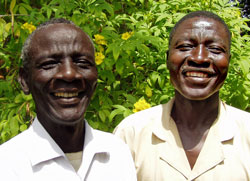
Meet our translators: Joseph DemanderWhen we think of Joseph, we think of that chap Nathaniel of whom Jesus said “He is a true Israelite in whom there is no guile.” Cut from the same block, Joseph will tell you things just the way they are in the full expectation you will agree. We have a long and good history with him. He is the only one of the original 6 translators that Mark began with in 1991 who is still on the job, and his fertile mind has come up with virtually every difficult or unusual vocabulary item which we have used in our Bible translation. He has the equivalent of an 8th grade education, but the independence of his thought, and the critical eye he brings to issues makes him the superior of those who have much more formal education. He has a modest family by Kwong standards – 9 children, of which only one has died. We saved his life with an emergency evacuation during rainy season for an appendectomy in 2006. He is not afraid to tell his fellow Kwong that for being one of the last tribes in Chad which still has its own missionary, they sure don’t seem to take much advantage of it. Similarly, back in about 1992 when I barely knew him, and a wildly popular play satirizing the white missionaries was making the rounds of the churches in Chad, he walked out remarking “These people come here and suffer, and we mock them like this?” He does have his faults, though. He has even less patience with foolishness than Mark, and his forthrightness can get him in trouble. Also, we never let him actually write anything, as the results are an unintelligible jumble of prepositions and participles connected by a species of hieroglyphics. And he is the only person we know who can turn an orderly stack of papers (say, the printout of a newly drafted book of the Bible) into a random collection of upside down and backward sheets of paper without even trying.Meet our Translators: François KinamatiWith Mark’s house
packed up and less than an hour before the MAF plane came to pick him up
for his journey home to get married in 1999, Pastor Old Moses accosted
him and asked “What about François – should he be a translator or a
pastor?” After mentioning that it was not an ideal time for such a
momentous discussion of someone’s future, Mark made the snap decision
of “pastor”. After all, as Mark remembered, François’ performance
on the little bit of translation checking he had done was considerably
less than stellar, and at the time, Mark already had a surplus of
mediocre translators. Mark was wrong, of course (neither for the first
time, nor the last), but his bad judgment procured for the Kwong not
just a good translator, but a bona-fide seminary-trained theologian who
is willing to live in an obscure village with none of the accolades and
fat paychecks his fellow laureates enjoy in the big cities. He lives
here with his wife Sidoné and 6 children. (Two others died in infancy.)
He
|
 Over the past couple years, our translation effort has accelerated as
projects such as the radio station and clinic have taken less of our
time. Presently, we are in the final stages of drafting the book of Acts
after just 4 months of effort. To date, we have translated about 30% of
the New Testament as well as Genesis. At this juncture, we thought you
might like to become better acquainted with the two Kwong men who are at
the center of this effort. They are Joseph Demander (left) and François
Kinamati.
Over the past couple years, our translation effort has accelerated as
projects such as the radio station and clinic have taken less of our
time. Presently, we are in the final stages of drafting the book of Acts
after just 4 months of effort. To date, we have translated about 30% of
the New Testament as well as Genesis. At this juncture, we thought you
might like to become better acquainted with the two Kwong men who are at
the center of this effort. They are Joseph Demander (left) and François
Kinamati. 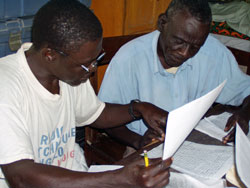 actually joined the translation effort in 2006 when Laurent, our
former head translator, left
to serve as a missionary to the Ndam tribe 80 miles to our east. He is
the sensible, what-does-the-text-actually-say counterbalance to the
Joseph’s think-outside-the-box exuberance. Perhaps remarkably
considering their different temperaments, he and Joseph get on well. He
does all the writing that we don’t let Joseph do, and it is rare that
we cannot make out what his neat handwriting says. He is soft-spoken and
gentle to a fault. We wish sometimes that as the best educated pastor in
Kwongland by far, and as someone who has internalized the doctrine and
spiritual qualities we cherish, he would exercise more of the prophetic
gift with the less diligent of his fellow pastors. But it isn’t in
him, and evidently is not his calling.
actually joined the translation effort in 2006 when Laurent, our
former head translator, left
to serve as a missionary to the Ndam tribe 80 miles to our east. He is
the sensible, what-does-the-text-actually-say counterbalance to the
Joseph’s think-outside-the-box exuberance. Perhaps remarkably
considering their different temperaments, he and Joseph get on well. He
does all the writing that we don’t let Joseph do, and it is rare that
we cannot make out what his neat handwriting says. He is soft-spoken and
gentle to a fault. We wish sometimes that as the best educated pastor in
Kwongland by far, and as someone who has internalized the doctrine and
spiritual qualities we cherish, he would exercise more of the prophetic
gift with the less diligent of his fellow pastors. But it isn’t in
him, and evidently is not his calling.